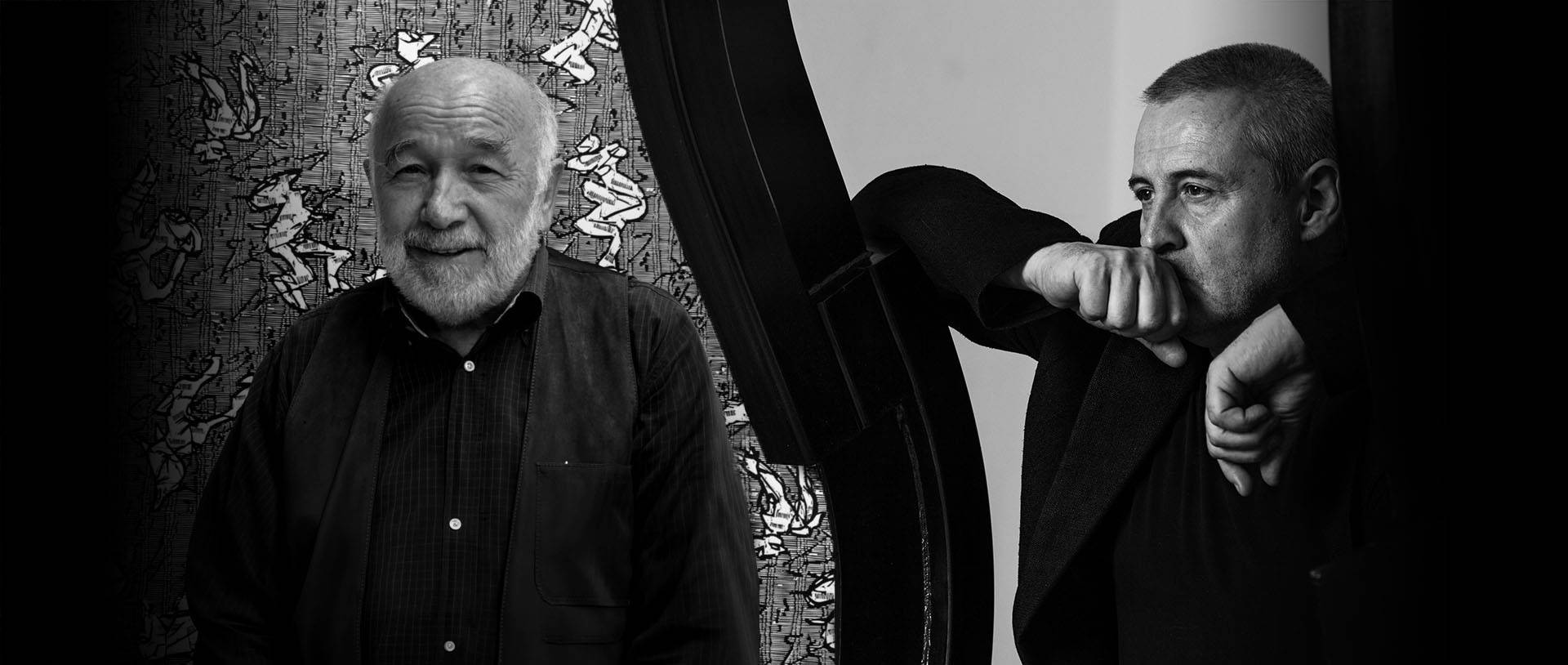
Erich Steininger. Layering and Breaking Down Boundaries
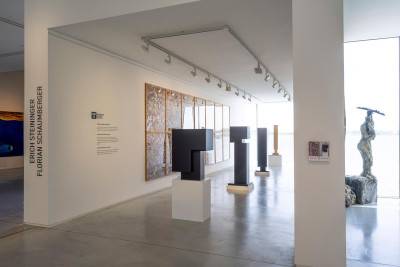
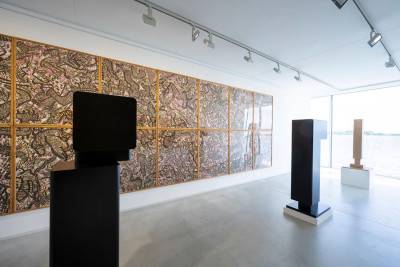
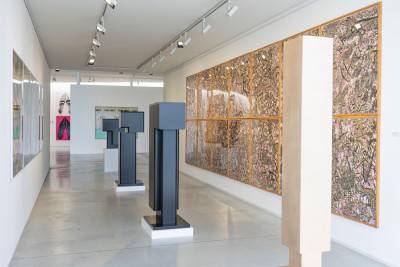
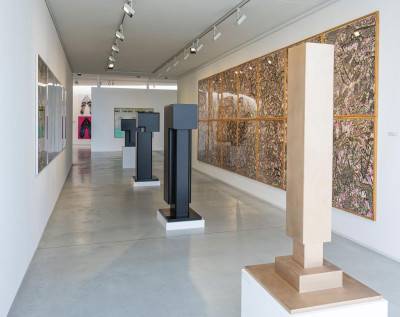
The work of Erich Steininger presented at the exhibition at the Danubiana Meulensteen Art Museum covers two decades of creation and brings together key groups from his extensive graphic work: a 14-part series of woodcuts from the 1990s and a five-part series of monotypes. Woodcut – a technique of lithography – represents a truly royal artistic discipline in his work.
Steininger’s woodcuts have been created with remarkable consistency and continuity since the mid-1960s. Initially influenced by a figurative and expressionist approach, they increasingly develop towards abstract-structural and ornamental pictorial worlds.
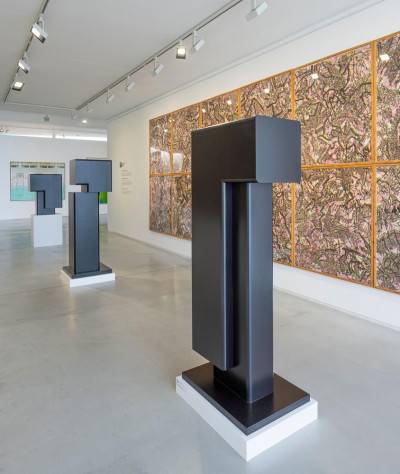
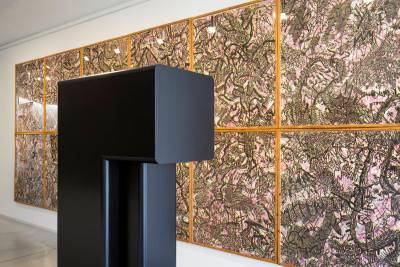
In the series of works entitled Body Becomes Land, pink, yellow, and black are superimposed using a complex printing process. By printing several plates on top of each other on one sheet, the figure and structure begin to blend, condense, and dissolve into each other. The line increasingly detaches itself from its purely descriptive function, becomes independent, and begins to form networks. The body breaks down boundaries – it becomes a landscape. The layering of colors, the interweaving of line and surface acts as a visual reflection of this hope – as if a process of liberation is taking place in the painting itself.
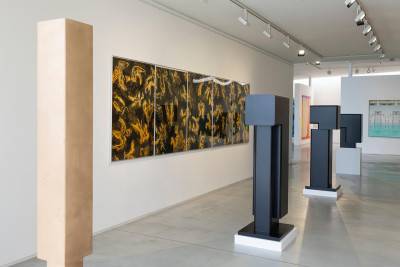
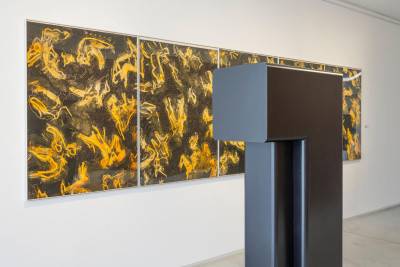
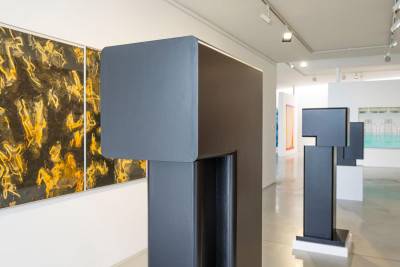
Monotypes bring a different, almost radiant accent. In this technique, an aluminum plate is first coated with black printer ink, which is then wiped off with a brush. The second plate brings a blazing, fiery orange color, as well as the black of the marks. This creates unique pictorial events – fiery, atmospheric, carrying an immediate painterly presence.
Barbara Steininger-Wetzlmair
Florian Schaumberger. Minimalistic Heads
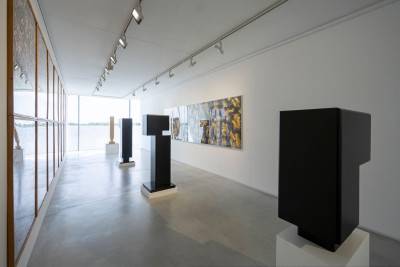
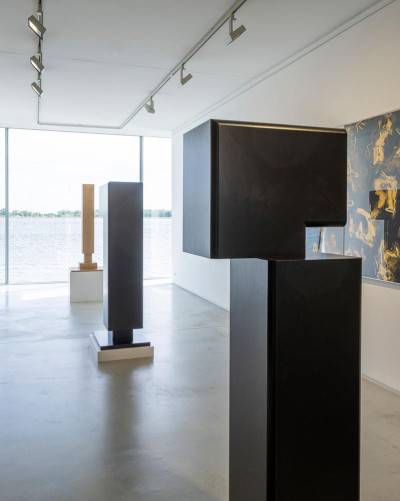
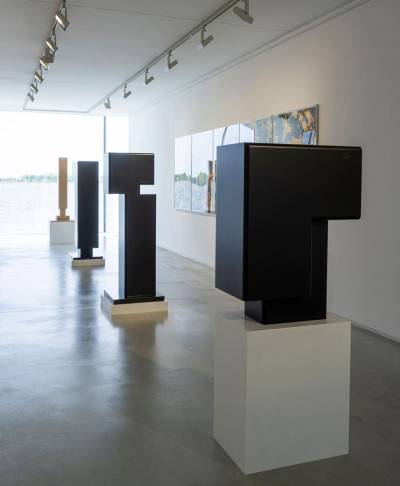
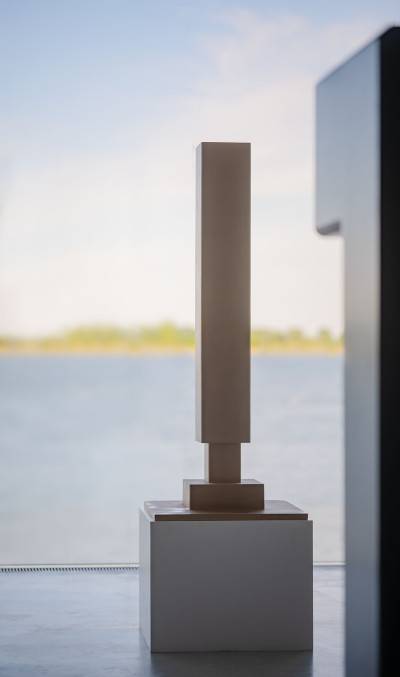
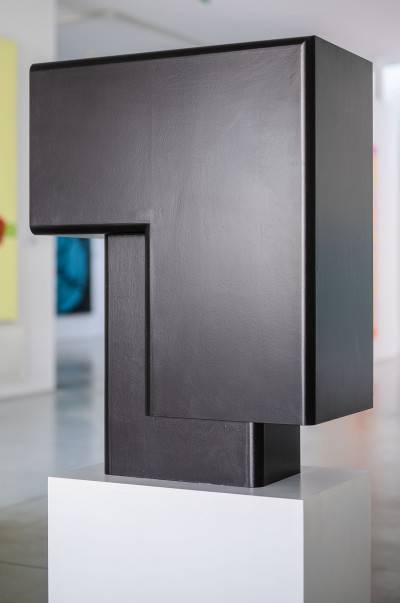
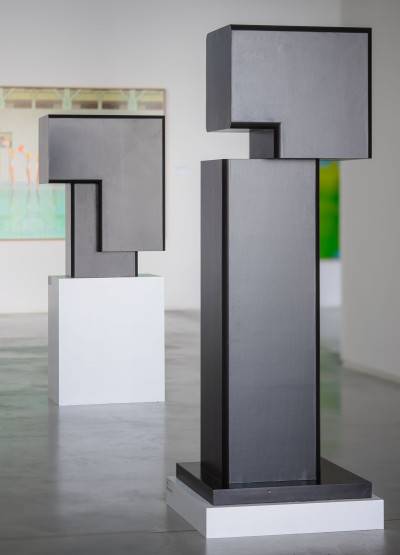
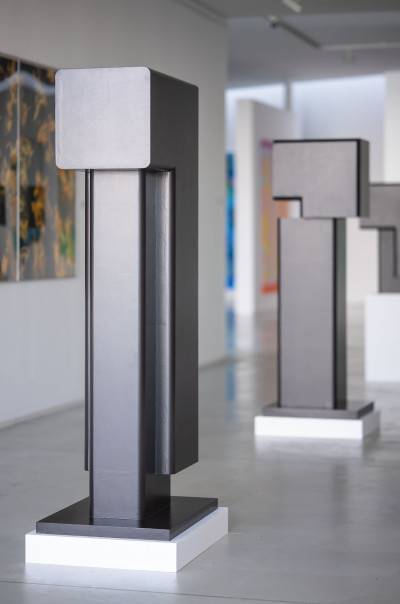
Florian Schaumberger's contemporary sculptural work is characterized by concepts such as materialization, minimalism, and a focus on elementalism. The works exhibited at the Danubiana Meulensteen Art Museum from the Head and Ahead series feature a combination of figurative and architectural approaches. In the Head series, cubic forms intertwine. The shape of the head is radically minimized and transferred to a vertical and horizontal coordinate system, and the organic shape is transformed into an architectural construction. Schaumberger studied at the Academy of Fine Arts in Vienna under Ioannis Avramidis, and was influenced by the Cubist school of sculpture of Fritz Wotruba, but the image of a person always remained the center of attention. He radicalizes the formal language into a minimalist concentrate bordering on abstract expression.
Schaumberger's works refer to humans and represent closed sculptural units. The Ahead sculptures are upright, columnar structures that resemble guardians. The sculptor starts with boards that are then cast in bronze; the golden-gloss version of Shining Ahead is a good example. In addition to the formal dimension, the sculptures radiate a spiritual power, something focused, contemplative, internal, present within oneself. Schaumberger's current works are diametrically opposed to his previous welded steel sculptures, which were characterized by dynamism, openness, and violent expressiveness.
Florian Steininger
Erich Steininger (1939 Oberrabenthan (Waldviertel) – 2015 Vienna)
1963 – 1970 studied graphic arts at the Academy of Fine Arts in Vienna
Member of Künstlerhaus Vienna; teacher, later pedagogical activities at the Academy
President of the Regional Association of Art Societies of Lower Austria (1995 – 2009), Director of DOK St. Pölten
His works are represented in important museum collections (e.g. Lentos and Albertina).
Florian Schaumberger
Born in 1962 in Vienna.
1980 – 1984 Higher School of Graphic Arts
1984 – 1992 Study of sculpture at the Academy of Fine Arts in Vienna under Professor Ioannis Avramidis
Since 1992 he has been intensively involved in large-scale sculptural works in public spaces and has participated in numerous competitions and exhibitions.